

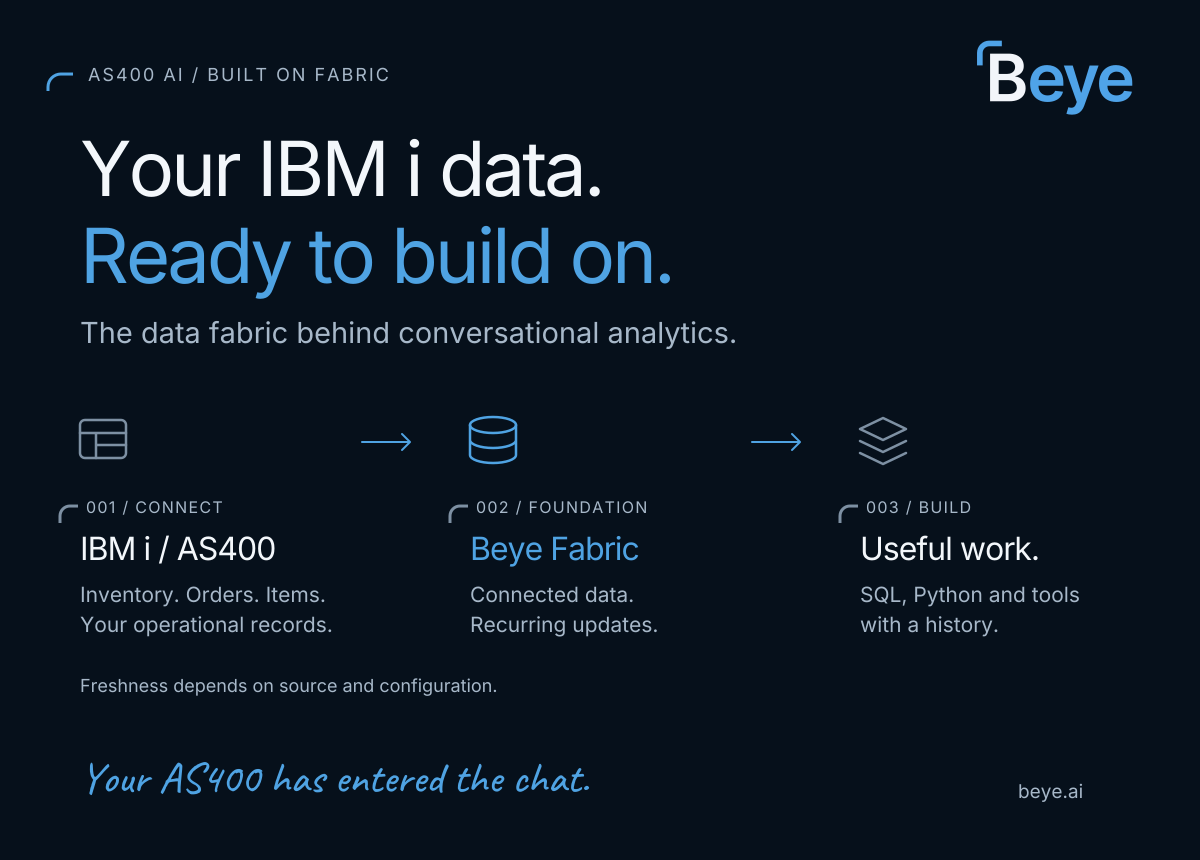
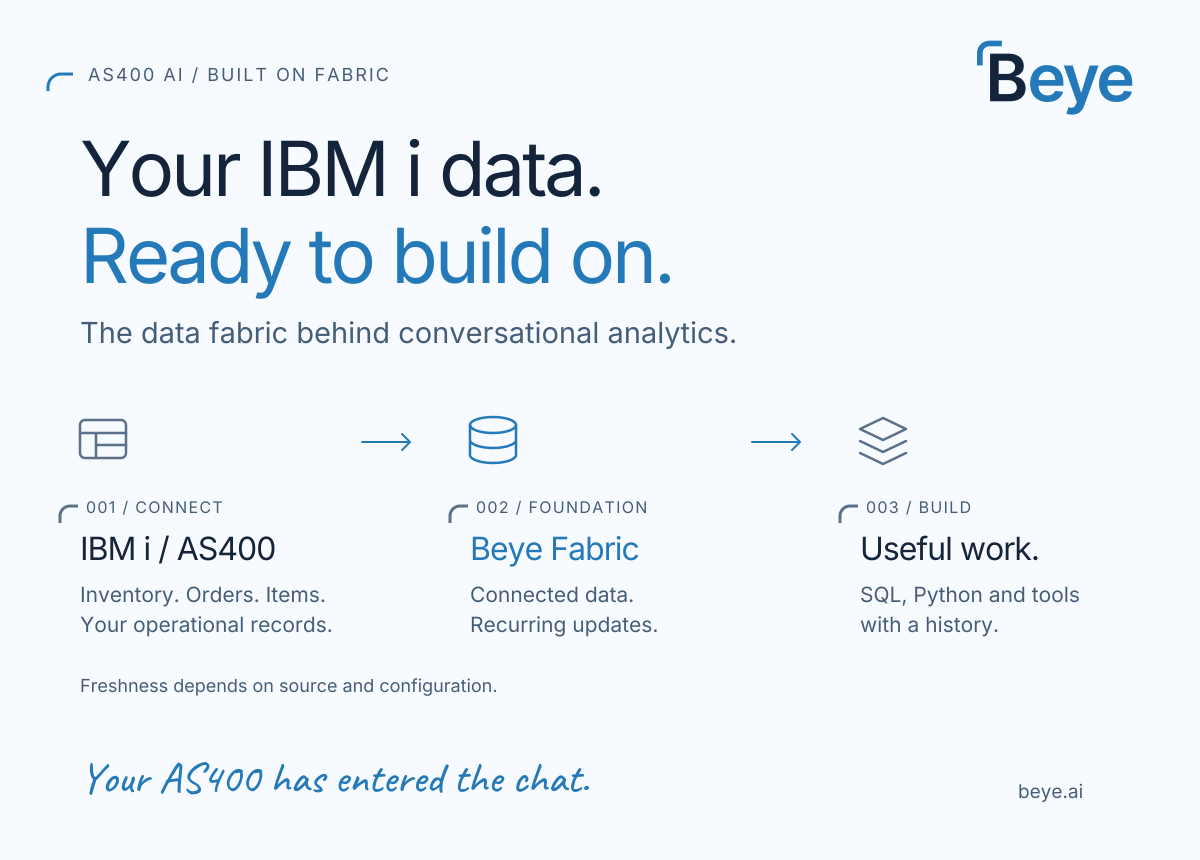
AS400 AI starts with making operational data available, understandable and useful for business work. For a team running inventory, purchasing or sales on IBM i, that means connecting the relevant records, defining what they mean, and giving people a way to explore them and keep the useful analysis.
The inventory system may be doing its job perfectly well. The frustration begins when a planner needs to combine stock balances, open orders and expected receipts, and the answer depends on another spreadsheet export or someone who knows the right tables.
Beye Fabric addresses that foundation: bringing supported source data into a maintained data layer for analysis and reusable business tools. Conversational analytics then gives the team a way to work with it in plain language.
Connecting IBM i operational data through a data fabric
Teams often use “AS400” or “AS/400” when discussing their IBM i environment. The specific system and database version matter during setup. Db2 for i is the relational database integrated into IBM i, and a connection needs to fit the environment actually running the business.
Beye Fabric is our data fabric layer. It brings relevant operational records into the platform and keeps pulling changes as the business runs. For an IBM i use case, that might begin with item masters, inventory balances, purchase orders and sales orders, rather than trying to connect every table before anyone can do useful work.
In Beye’s enterprise agentic stack, the data fabric provides the foundation for working with connected operational data. Conversational analytics helps users explore it, while reusable business tools let the team keep useful calculations and run them again with new inputs.
The source fit still needs to be established. Beye’s connector includes an AS/400 provider using ODBC, with the IBM i Access ODBC driver required for that connection. Deployment requires suitable network access, credentials and access to the selected data. Custom ERP structures and business-specific fields need review; a supported database connection does not automatically explain an application’s schema.
The connector can run on a customer on-premises machine to extract selected data for the platform. During setup, agree which records are included, where extracted data is processed and stored, and what access the connection needs. Review documented controls in the Beye Trust Center.
A maintained data layer, beyond a one-time export
An inventory question changes when an order is booked, a receipt is delayed or stock is allocated. A spreadsheet exported last week cannot tell the team what changed since then without another collection step.
Beye Fabric supports recurring, CDC-style ingestion. The connector retains progress between runs and supports different update cadences for different tables. Operational visibility includes extraction run status, schema-change history and the backlog between extracted data and data applied by the platform.
Freshness depends on the source, extraction configuration and processing progress. CDC-style ingestion here should not be read as a promise of instant streaming or log-based change capture for every source. Decide how changes and deletions will be handled for the selected tables, and check that the resulting freshness fits the decision being made.
For example, a daily planning review and a decision about an order being picked now may need different update expectations. Set those expectations before asking either workflow to depend on the data.
Capturing business definitions and context
A data fabric makes the records available. Business context makes them interpretable.
“Available inventory” might mean on-hand stock, on-hand less allocations, or stock that also excludes damaged and quarantined units. Joining tables correctly is necessary, but it does not settle which of those definitions a planner intends.
We work with the people who use the data to establish the relationships, rules and assumptions behind the analysis. For a purchasing workflow, useful questions include:
- Which item and location keys connect balances, orders and receipts?
- Are quantities stored in cases, individual units or another measure?
- Does open demand already include allocated orders?
- Which order statuses should be included or excluded?
- Is an expected receipt date confirmed, estimated or overdue?
These definitions need an owner and a place in the team’s working documentation and calculation logic. When an assumption changes, update and review the affected tool. A model should not have to guess what an unfamiliar status code means, and a new team member should not have to reverse-engineer the same spreadsheet again.
The data fabric and business context have distinct jobs: Fabric maintains the connected data foundation; agreed definitions guide how the team uses it.
Asking questions and inspecting SQL and Python
With the relevant data connected and its meaning established, conversational analytics lets a user describe the work they need. For example:
Which items are at risk of running short before their next confirmed receipt, after accounting for existing allocations?
Answering that question may require stock balances, order commitments, receipt dates and a planning horizon. Beye can generate and run SQL for data analysis, and execute Python in sandboxes for calculations that need more than a query alone. Users can inspect the query, code, execution steps and result behind the work.
For an illustrative item, suppose the team has 120 units on hand, 40 allocated and 100 units of additional expected demand before the next receipt. If the demand does not overlap the allocations and there are no earlier receipts, the projected balance is 120 − 40 − 100 = −20 units.
That is a calculation to inspect, not an instruction to place an order. A planner should check the source records, units, demand assumption and receipt timing before deciding what to do. If the Fabric update is delayed, the analysis also needs to be understood in that light.
For a broader introduction to this workflow, see What Is Generative BI? Conversational Analytics Explained.
Saving useful logic as reusable business tools
The first useful answer often exposes a repeatable job. If a planner checks shortage risk every morning, the team should be able to keep the calculation and run it with new inputs.
Beye lets users build reusable business tools with input forms and executable logic. An inventory review could take a location, planning horizon and demand assumption as inputs. The next user changes those inputs and runs the tool against the connected data instead of rebuilding the analysis from another export.
This is where the Fabric layer keeps contributing. A reusable tool depends on a maintained data foundation as well as a useful calculation. If a source field changes, an extraction fails or a business definition is revised, the team needs to review the effect on the work that uses it.
Give the tool a clear purpose and someone responsible for its logic. Check it against familiar records before sharing it more widely. Plain-language creation makes the work accessible; validation and ownership make it suitable for the team’s process.
Keeping revisions and previous runs
A tool becomes more useful when the team can inspect how it evolved and what it produced.
Beye’s collective history retains attributed revisions to Python, forms and layouts. Previous runs retain inputs, the revision used, timing and results. That lets a colleague investigate questions such as “Which calculation produced this result?” or “What changed between these two runs?”
That history complements the data fabric’s operational visibility. Connector status helps explain whether the connected data is current; tool revisions and run records help explain the analysis performed with it.
A saved run is not a guarantee that rerunning the same inputs later will produce an identical result. Source data, definitions and the execution environment can change. Review those conditions when comparing results or investigating a difference.
Suggested-order agents: coming soon
Beye’s automated agents are coming soon; they are not available today. The current workflow is interactive analysis and manually running reusable tools. A planner can investigate shortage risk and review a calculation now; that should not be confused with a proactive agent placing or updating orders.
The planned agent layer will support event-driven, cron-scheduled and manual triggers, with table writes and email sending. A future inventory-review agent could use that foundation to flag potential shortages for review. The exact workflow, source access and business rules would still need to be configured and validated.
Building the connected data foundation, checking the calculation and assigning ownership are useful preparation. They are not a claim that automated suggested-order execution is already deployed.
Start with one IBM i workflow
Choose a recurring decision your team already understands: an inventory review, an exception report or a purchasing calculation. Identify the source records and definitions it needs, then agree on an update cadence that fits the work.
Bring those pieces together through Beye Fabric, inspect the first analysis, and keep the useful logic as a tool with a history. That is a practical route from IBM i data to conversational analytics and reusable work, without making an ERP replacement the starting requirement.
Beye is a boutique enterprise agentic stack: a data fabric and workspace to build and run tools safely on YOUR business data. Explore the platform overview, or bring us one workflow for a proof of value.