

Generative business intelligence (Generative BI, or GenBI) uses generative AI to help people create and explore analysis of business data. A user describes a question in plain language, and the system can generate queries, calculations, explanations or visualizations to help answer it.
The useful outcome is an analysis the team can inspect: what data was used, how a calculation was made, and whether the result answers the business question. A fluent explanation alone does not establish that the answer is correct.
Conversational analytics is the question-and-follow-up experience within that process. It lets a business user explore connected data without having to write every query themselves. Generative BI can also help create the analytical work behind the conversation, such as SQL or Python calculations.
How does conversational analytics work?
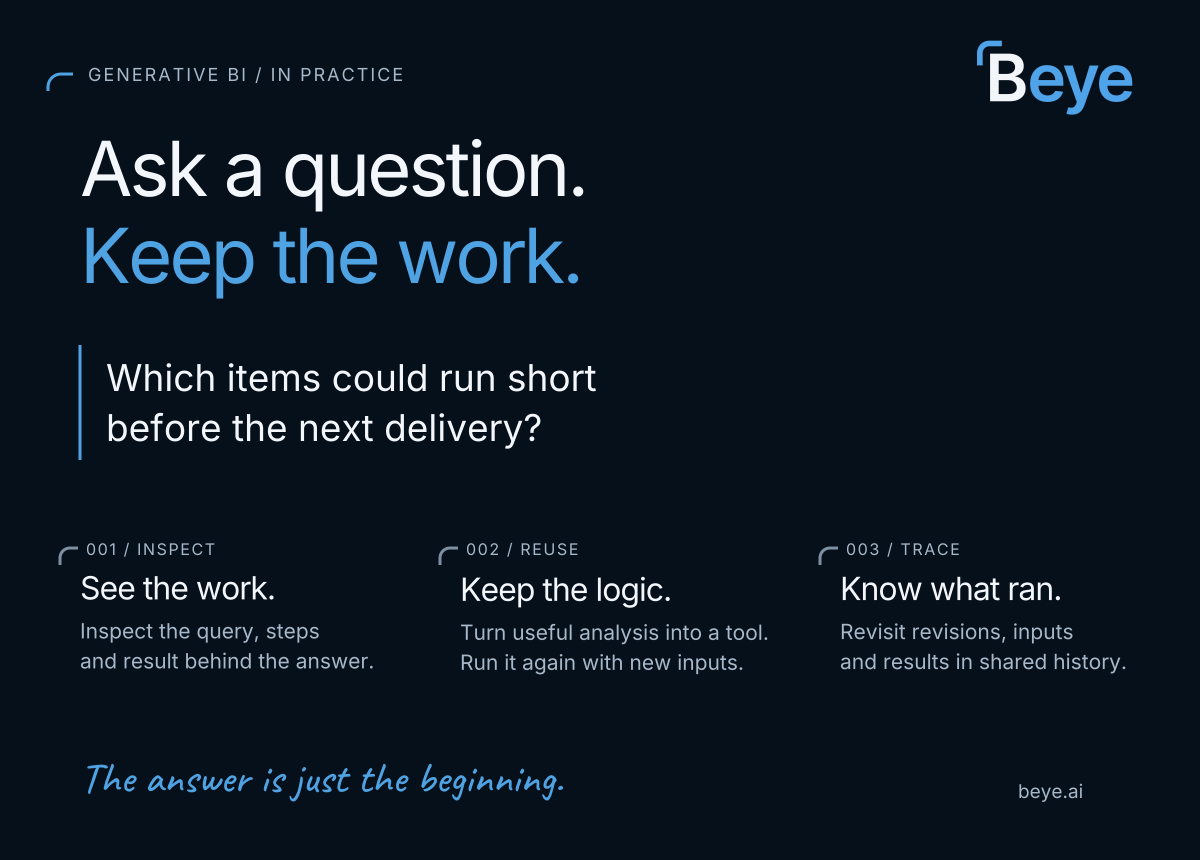
Consider an illustrative example: a purchasing manager at a distributor asks, “Which items could run short before the next delivery?”
Answering that question takes more than reading an inventory table. The analysis may need on-hand stock, open orders, expected receipts and demand assumptions. The team also needs to agree on what counts as available stock and which delivery dates are reliable.
A useful workflow looks like this:
- Connect the relevant data. Bring the inventory, order and purchasing records into the analytical workspace through supported connections.
- Clarify the business rules. Define available stock, the planning horizon and any exclusions. If a needed field or definition is missing, resolve it before treating the result as a recommendation.
- Generate and run the analysis. The system can produce SQL or Python to calculate projected balances using those inputs and assumptions.
- Inspect the work. Review the query, calculation and results. Check a sample against records the purchasing team understands.
- Ask the next question. Explore how the answer changes if a receipt is late or demand increases. A follow-up should make its changed assumptions clear.
For one item, suppose there are 120 units on hand, 40 already reserved, and another 100 units of expected demand before the next delivery. If those demand figures do not overlap and no stock arrives sooner, the projected balance is 120 − 40 − 100 = −20 units. The manager can inspect that calculation, check the demand assumption and investigate a possible 20-unit shortage.
The numbers are illustrative. The important work is making the inputs and assumptions visible, especially whether reserved orders have already been counted in the demand forecast.
How is Generative BI different from traditional BI?
Traditional business intelligence provides established reports, dashboards and analytical models. Those remain useful for recurring reporting and agreed metrics. Generative BI adds a way to create and adapt analysis through natural language.
| Task | Established reporting workflow | Generative BI workflow |
|---|---|---|
| Answer a recurring question | Open a prepared report or dashboard | Use the prepared content, or ask a question against connected data |
| Explore a new question | Adapt a report or write an additional query | Describe the analysis and review the generated work |
| Change an assumption | Adjust a filter, parameter or calculation | Explain the change, then inspect how the calculation responds |
| Trust the result | Review definitions, calculations and source data | Review those same foundations, plus the AI-generated query or code |
These approaches overlap. An existing BI tool may also offer conversational features. The important buying question is what the system can do with your data, how clearly it exposes its work, and what your team must configure and maintain.
Where Generative BI fits in an enterprise agentic stack
Conversational analytics lets teams ask questions about business data in plain language and inspect the work behind an answer. It is one part of an enterprise agentic stack: the wider foundation connecting data, analysis, execution, reusable business tools and traceable work.
We use that phrase to describe Beye’s broader approach. It is a way to explain the layers and their responsibilities, rather than a claim that every product in this category has the same architecture or capabilities.
| Layer | Its role in the work |
|---|---|
| Data fabric | Connect operational sources and bring data together for use. Freshness depends on the source and configuration. |
| Business context | Establish the definitions, relationships and assumptions needed to interpret the data. |
| Conversational analytics | Explore questions, follow-ups and the analysis behind answers. |
| Execution | Run queries and calculations against the relevant data. |
| Reusable business tools | Keep useful logic with inputs so a team can run it again. |
| Collective history | Retain revisions and run records so people can inspect how work changed and what was run. |
| Automated agents | Extend suitable work to scheduled or event-driven execution. Beye’s automated agents are coming soon. |
The distinction matters because asking a question, running a calculation and automating a process are different capabilities. Evaluate each separately. See the Beye platform overview for more about our approach.
From one answer to a reusable business tool
Return to the purchasing example. Once the team has checked its stock projection, it may want to use the same logic next week with a different planning horizon.
That is an opportunity to turn the analysis into a reusable business tool. Keep the calculation, give it an input form and identify who is responsible for maintaining it. The next user can change the inputs and run the work again instead of rebuilding the analysis.
Traceability becomes useful here. Which revision produced the result? What inputs were used? Who changed the calculation? What did the previous run return?
Saved inputs and code history help investigate those questions. They do not, by themselves, guarantee identical results later: the underlying data and execution environment may have changed. Teams still need appropriate validation and clear ownership.
What Beye provides today, and what is coming next
Beye is a boutique enterprise agentic stack: a data fabric and workspace to build and run tools safely on YOUR business data. Our product walkthrough shows how these pieces support business work.
Today, Beye connects existing systems through its data fabric, supports natural-language exploration with inspectable queries and execution steps, runs Python in sandboxes, and lets teams build reusable tools with inputs. Attributed revisions and previous runs retain the work’s history, including run inputs and results.
“Safely” needs concrete meaning. Sandboxed execution provides a boundary for running Python; inspectable revisions and runs help people review what happened. These controls support responsible use, while teams remain responsible for checking business logic and deciding how results should be used. Review our Trust Center for documented security controls.
Automated agents are coming soon. The planned agent layer will support event-driven, scheduled and manual triggers, building on the existing tools and execution foundation. Those forthcoming capabilities should not be confused with interactive analysis or manually running a reusable tool today.
What should you check before choosing a Generative BI platform?
Start with one real business question and ask each vendor to work through it on relevant data.
- Source fit: Can it connect the systems you actually use? What additional integration work is needed, and how often will data update?
- Context: How are business definitions and assumptions established? What happens when a question is ambiguous?
- Inspection: Can you see the query or code, its inputs and its results? Can someone on your team validate the calculation?
- Reuse: Can the analysis become a tool that colleagues run with new inputs? Who maintains it?
- History: What revisions and run records are retained, and who can inspect them?
- Maturity: Which capabilities are available now, which depend on setup, and which are still planned?
Our Beye vs C3.ai comparison uses those distinctions to compare approaches with public sources beside the claims.
Start with work your team already needs to do
Generative BI can make business data easier to explore, but the value comes from answering a useful question and keeping work the team can trust and reuse. Start with the decision, establish the data and definitions, inspect the calculation, then decide what should become repeatable.
Bring an inventory question, a recurring calculation or the spreadsheet your team keeps rebuilding. Explore a proof of value with Beye to work through a use case and agree on how to evaluate it.