

001 / Summary
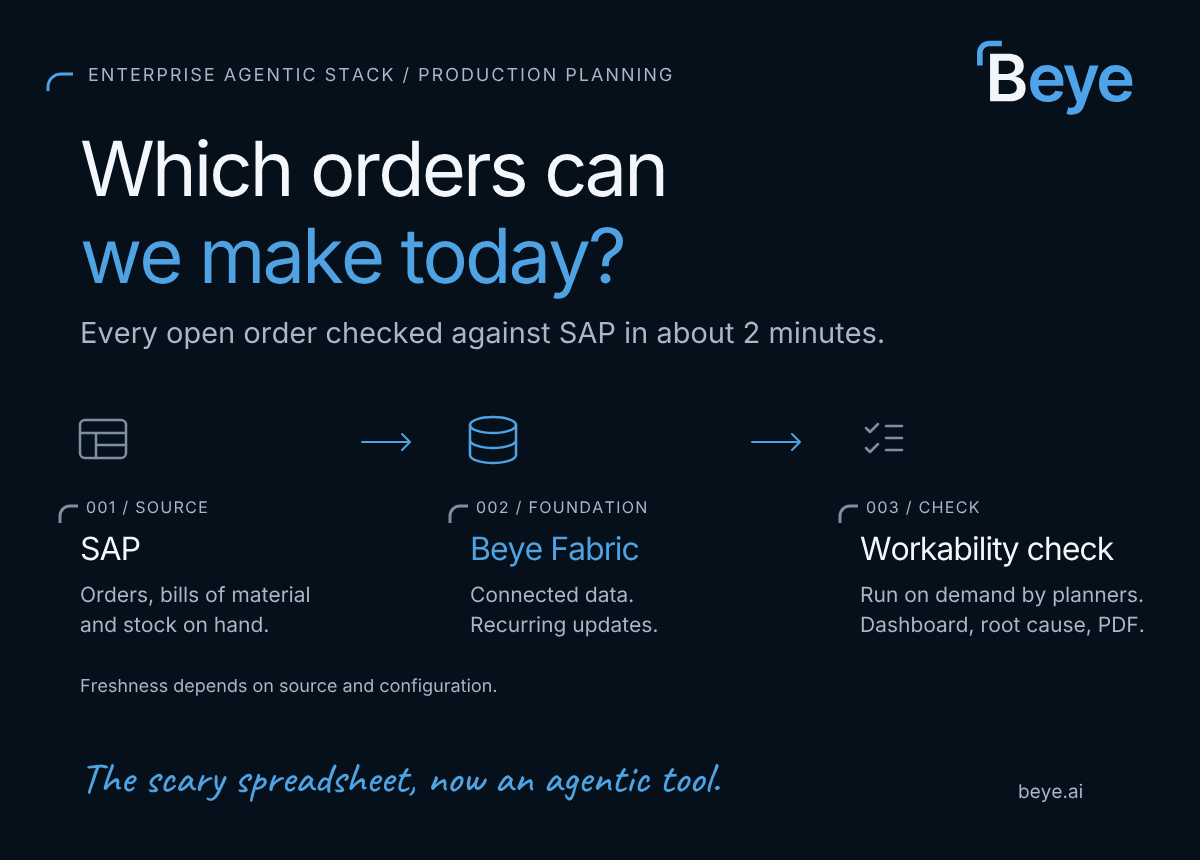
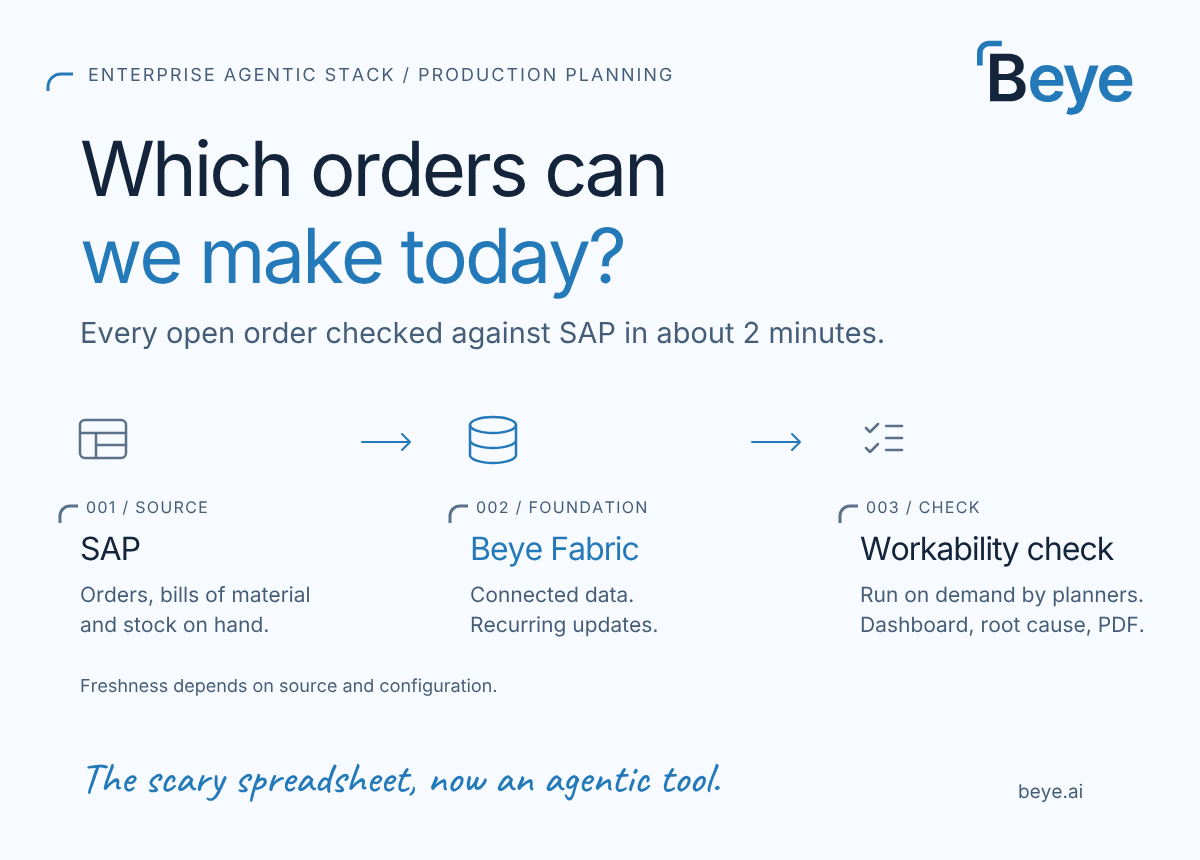
A North American 3PL and manufacturer who manufactures vinyl discs (physical media) is leveraging the Beye enterprise agentic stack to determine the workability of inbound production sales orders, in other words which orders can be made today and which ones are blocked. This is now a live process: the data flows in automatically through recurring updates from the source ERP system, in this case SAP, and the planners run the workability check on demand whenever they need it.
Who is using it? Operations, manufacturing planners, and supply chain planners. These are practitioners who have technical ability in analyzing data, but not engineering. These are business colleagues using this system.
002 / The issue
The issue: production planning and scheduling beyond Excel and SAP
The key problem is complex mathematical calculations and computation: color mixing for vinyl discs and all the dependencies in the manufacturing process. Excel was not really able to handle it, and there was no way to do that directly in SAP.
All of the data was maintained in SAP, and the team had built a mini system via a series of Excel files using Power Query and macros. The explainability and maintenance required to make decisions and create scheduling plans was time intensive and cumbersome, where a select few had the technical skill set to build the reporting around where to focus.
The operations and planning teams were responsible for maintaining the process and building the queries in the “old way” of doing things.
As the business was growing, the process in its current form did not scale.
003 / Requirements
What the team required from an agentic AI platform
The team needed a layer on top that provided value on optimizing the production workflow and scheduling, determining the inventory right sizing for raw materials, the flow of material, and the bottlenecks.
They also required:
- Time to value
- An intuitive, near real time way to connect to source systems without having to invest in an integration and data warehouse layer
- Reducing the TCO, as Beye serves as this end to end agentic stack for the customer
- Predictability on the AI usage front: predictable pricing, not worried about ballooning token spend, and visibility. What value is my team getting out of it? Where is the visibility into what we are actually building with AI?
Through our harness we ensure controlled token spend, model routing, tool use, and guardrails, and the team can inspect and validate every calculation against their own numbers. All of this is baked into the Beye model so that ROI can be measured.
004 / What we did
So what did we do: an enterprise agentic stack on SAP data
Step 1: connecting the SAP data
First, after understanding the business use case on workability, we were able to leverage Beye Fabric, our proprietary data fabric and AI data readiness layer built for enterprise. It has read only access to SAP behind the customer’s four walls, and we were able to identify all the source information required to fulfill the requirements from the customer.
Material master and customer master data, production orders, purchase orders, bill of material, and inventory: all of this data is wired via Beye Fabric. The Beye connector is able to ETL the data and build a data warehouse on behalf of the customer, and a set of metadata is stored on the data so the analytics harness can leverage its understanding of the data to answer ad hoc Q&A through conversational analytics. The team can also build dashboards via the harness and publish them to Stacks, a collection of dashboards and tools to organize the business teams on their use cases.
Step 2: capturing the business rules
It all starts with this data layer: ensuring data quality, harmonization, a data/semantic model, and knowledge graphs, after meeting business users where they are, understanding this process, and ensuring there is an intuitive way to capture all this first-party information, process, and business rules directly into the system itself.
Using the agentic stack, we were able to take the existing logic and business rules the team had in Excel and Power Query, replicate them 1:1 as a baseline, and then make them even more powerful with the tool capabilities.
From there, the customer is leveraging the agentic stack to build a reusable business tool on their ERP data that is able to detect the workability of sales orders of vinyl physical media, while considering the manufacturing lead time and the on-hand and bill of material of key inputs like PVC, sleeves, and center labels. It works in queue order, so an order further down the line is judged on what is left after the orders ahead of it, and it carries the plant’s own rules, like color mixing, the size of the discs, and other complexities in the manufacturing process. These are the complex mathematical calculations and computations that our tooling builds using sandboxed Python execution.
Step 3: running it and reusing it
The planners run it on demand and it spits out a dashboard on what is workable and what is not, text explainability on the root cause and what happened, and an executive PDF report summarizing the key findings that can be shared and actioned upon. A full refresh of every open order runs end to end in 2 minutes on the latest data coming in from SAP, as timed by the plant’s planning lead. In practice, the scheduler opens it before the shift meeting, sees which orders are waiting on one PVC color and when that purchase order lands, and sends purchasing the list to chase.
The workability check is one of the reusable business tools on the stack, and the more important point is that it is extended in a controlled manner: it is customizable and version controlled, with access control over who can view and edit it, and a collective history of every change to the tool, so there is auditability of what changed. It is also democratized, so the explainability and the ability to make edits is as simple as writing the instructions to the harness and it takes care of it, and all of it stays controlled and secure.
Today the planners kick off each run, and enterprise AI agents that run on their own off an event or a schedule are coming soon on the Beye agentic stack.
005 / Results
As a result: AI for manufacturing data that gives planners about 9 hours a week back
| Before | With Beye |
|---|---|
| Business rules spread across Excel, Power Query and macros | The same rules replicated 1:1 as a baseline, then extended with Beye’s tools |
| A select few on the operations and planning teams could change it | Any planner can run it, and changes ship as new versions |
| About 23% of the work week getting data together (team estimate) | About 9 hours a week back per person (team estimate) |
As a result of what we were able to build:
- About 9 hours saved a week per person across the operations and planning teams, based on their own estimate. About 23% of their work week was invested in getting the information together to make these decisions, and that time is now saved.
- The team is focused on making more informed planning and scheduling decisions vs. getting the data altogether.
- They can manage production scheduling with the team they have and do not need to onboard net new people.
- They simplified the process by not having to manage and maintain data in multiple spreadsheets.
- They are not bottlenecked by a select few who can run or change the macros and Power Queries.
- Capabilities are now democratized across the group, and they can do more with what they have today.
006 / Your next step
The Beye analytics harness and boutique enterprise agentic stack offers manufacturers and distribution teams these bespoke capabilities to leverage AI in a controlled, governed way that is predictable, so that ROI can be recognized vs. wishful thinking. If you have a production planning workflow your team is still holding together with spreadsheets, bring it to us and we will build it end to end in a 4-week proof of value.